
All Germany
The
area outlined in white on the map is the Southern German campaign area.
The
Austrian main supply base is at Prague (far right), and the Bavarian base is at
Strasbourg
(far left)
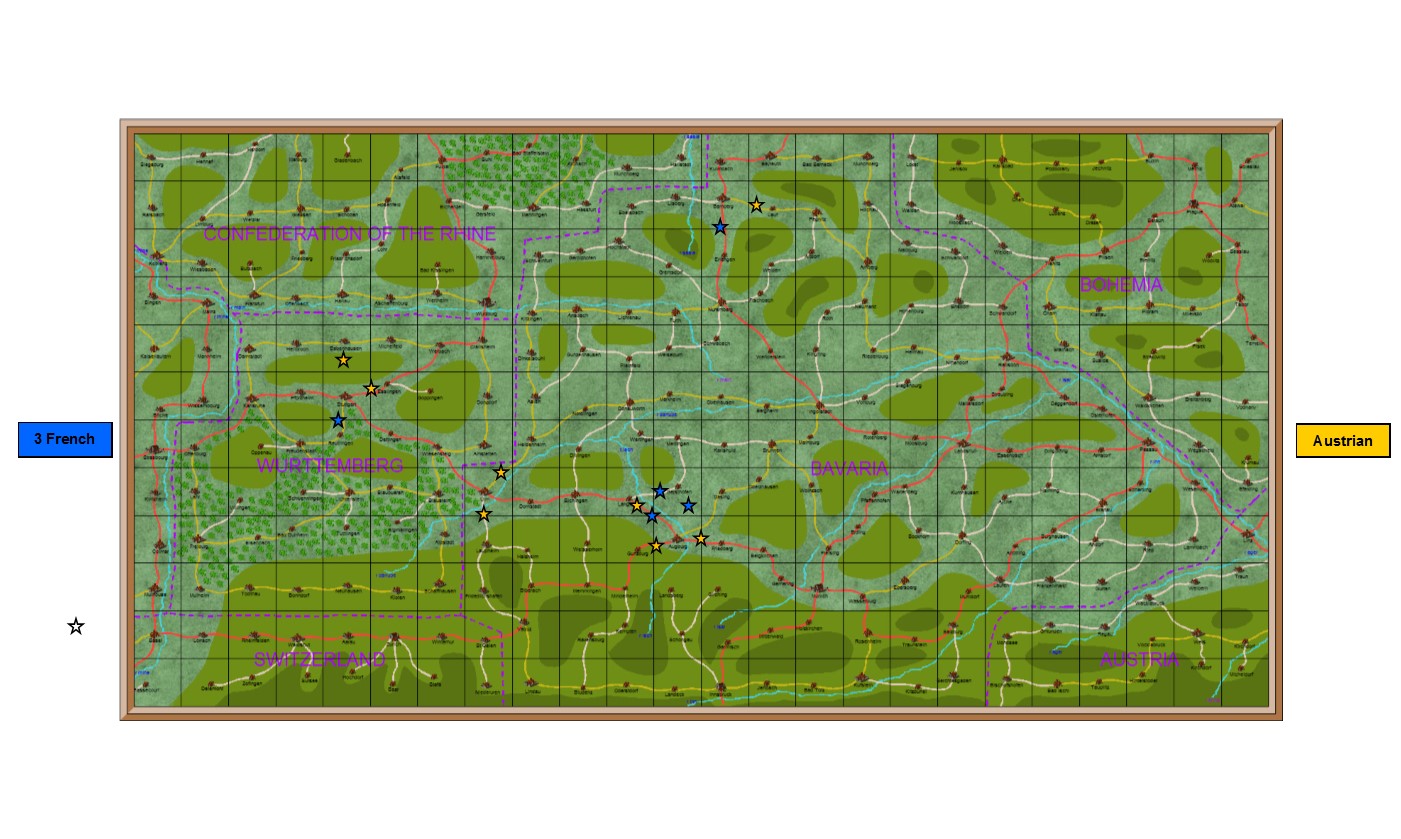
Southern Germany with
battles fought
At
the start of February 1813 Napoleon believed that the Austrians were his loyal
allies. He was unaware of the secret
treaty signed by the allies on 1 January 1813 which agreed that Prussia,
Russia, Austria, England and Spain would all declare war on France.
On
15 February 1813 Marshal Schwartzenberg crossed the Bavarian border and
dispersed the small covering force and took the city of Passau
The
majority of the Bavarian Army was in northern Germany as part of Napoleon’s new
Grande Armee. He considered the
Austrian’s to be allies, and only a small reserve Army was left in Bavaria to
contain the ongoing rebellion in the Tyrol.
Schwartzenberg
defeated the Bavarian Army and entered Munich on 20 February 1813.
On
receiving news of the Austrian betrayal and invasion of Bavaria, Napoleon
ordered Marshal Oudinot to form the Third French Army from the Bavarian and
Baden troops forming part of the Grande Armee and march south to drive
Schwartzenberg out of Bavaria.
By
the end of February 1813 Oudinot had concentrated the newly formed Third French
Army at Ulm and was ready to cross into Bavaria and engage the Austrians.
Schwartzenberg
had secured Munich and deployed his Army just west of the city.
1
March 1813 – Augsburg Campaign. The
Bavarians advance and win the battles of Augsburg and Donauworth. However the Austrians recover, counter
attack and win the second battle of Donauworth. The Bavarians retreat and are defeated again
at second Augsburg. The Bavarians
retake Donauworth but are decisively beaten at Augsburg. The Bavarians retreat west.
16
March 1813 – Ulm Campaign. The
Austrians pursue and win the battles of Ulm and Goppingen. Once more the Bavarians are forced to
retreat west.
27
March 1813 – Stuttgart Campaign. The
Bavarians win the opening battle at Stuttgart.
But they are defeated at Ludwigsburg and second Stuttgart. The Austrians have won a third campaign
5
April 1813 – Armistice. Schwartzenberg
accepts Napoleon’s seven day truce. He
does so in order to shift his army from Bavaria north to Bamberg to join forces
with the Prussian and Russian armies.
Oudinot reacts by moving his army north to Darmstadt.
12
April 1813 – Bamberg Campaign. The
Bavarians win the first battle at Konigsfeld.
But they are defeated when the Austrians counter attack and win the
second battle of Konigsfeld. The
Austrians win the Bamberg Phase.

Erlangen Strategic Map
This extract from the strategic map is the Erlangen campaign area. Each square on the map is one square on the wargames table.
The Bavarian main supply base is at Furth and the Austrian at
Bamberg. This map is for information
only, it is not used for map movement.

Erlangen Tactical Map
This
is the campaign map for movement and transferring battles to the wargames
table. Each square is 7 miles or one
2x2 foot scenic square on the wargames table.
There is one scenic square showing the same detail as each square on the
map. Nine of these squares (3x3) are
used to create the wargames table. When
a battle is declared the point of impact (the centre square) is the same on the
map and on the table.
Background to the
Erlangen Campaign
Oudinot
and Schwartzenberg have already fought four campaigns. The Austrians have won all four. Both armies have rested, regrouped and are
fully operational.
Oudinot
must reverse the run of Austrian victories if he is to prevent the total loss
of Bavaria.

Third French Army
Marshal
Oudinot
9th
Bavarian corps
10th
Bavarian corps
11th
Bavarian corps
12th
Baden corps
Each
corps has four infantry brigades, one cavalry brigade and corps artillery
There
is also a reserve corps of four infantry brigades for garrison duty

Austrian Army
General
Schwartzenberg
1st
Austrian corps
2nd
Austrian corps
3rd
Austrian corps
4th
Austrian corps
Each
corps has four infantry brigades, one cavalry brigade and corps artillery
There
is also a reserve corps of four infantry brigades for garrison duty

